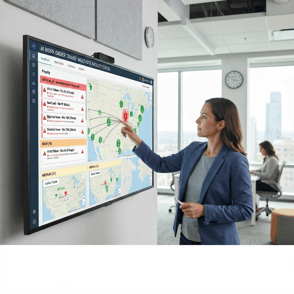
Your facilities are operating 24/7, consuming electricity constantly. But does anyone know if that consumption is necessary - or wasteful?
Most organizations can't answer this question. Without real-time energy visibility, inefficiencies hide in plain sight: equipment running during closed hours, poorly controlled climate systems, aging infrastructure degrading undetected. The result: 10–30% of facility energy budgets represent pure waste - money flowing out of the business with zero operational benefit.
This guide identifies five clear warning signs that your organization is wasting energy. If your facilities show these patterns, you're likely leaving €5,000–€50,000+ annually on the table, depending on your operation's size.
Sign #1: Your Facilities Consume Significant Energy Outside Business Hours
The Warning Sign: Energy consumption does not drop meaningfully when your facilities close.
The Reality:
In Miguel Neto's - Nextbitt's EAM Consultant - Portuguese bank case study, a typical facility shows this pattern:
The 1–2 kWh baseline represents residual load: security systems, emergency lighting, server room cooling, minimal HVAC to preserve facility integrity. Some residual load is necessary and unavoidable.
But most organizations' residual load is 3–5x higher than necessary—indicating:
-
HVAC systems running unnecessarily: Climate control should dial back to bare minimum after hours
-
Lighting left on: Security and emergency lighting are necessary; general lighting is not
-
IT equipment in standby: Servers, workstations, printers running in sleep mode rather than powered down
-
24/7 equipment operation: Refrigeration, compressors, or other systems running continuously despite intermittent need
Financial Impact:
Off-hours waste at one facility: €394/year (assuming 1 kWh unnecessary consumption × 8 off-hours × 365 days × €0.12/kWh)
Across a 50-location organization: €19,700/year in preventable waste
Across a 100-location organization: €39,400/year in preventable waste
The Fix:
Implement time-based controls for HVAC and lighting. Schedule climate systems to maintain minimum safe temperatures only. Use motion sensors for lighting where feasible. Power down equipment completely rather than leaving in standby mode. Result: Achievable 30–50% reduction in off-hours consumption with no operational disruption.
Sign #2: Your Consumption Spikes Unexpectedly, Without Clear Operational Reason
The Warning Sign: Month-to-month energy consumption varies significantly, despite consistent operational patterns.
The Reality:
Consumption should follow predictable patterns: weekdays higher than weekends, summer higher than winter (due to cooling), holidays lower than business days. Significant deviation from these patterns signals problems.
Real Example from Miguel Neto's Case Study:
Vila Verde branch (one of five branches studied):
-
Expected daily consumption (based on peer facilities): ~4.5 kWh
-
Actual daily consumption: ~5.13 kWh average
-
Unexplained spike: +14% above benchmark
Investigation revealed:
-
HVAC system thermostat set to 22°C continuously (rather than seasonal adjustment)
-
Building envelope degradation (poor sealing, aging windows)
-
Equipment running on backup mode unnecessarily
Why This Matters:
Unexpected spikes aren't random. They indicate:
-
Equipment malfunction (compressors, motors operating inefficiently)
-
Control system failure (timers not working, thermostats miscalibrated)
-
Occupant behavior change (leaving systems on unnecessarily)
-
Seasonal transition mismanagement (not adjusting controls for summer/winter)
Financial Impact:
Vila Verde's +14% excess = €2,500 additional annual cost at one location
Across multiple locations, this represents significant hidden expenses.
The Fix:
Establish consumption baselines by location and season. Set alert thresholds: if monthly consumption exceeds baseline by >5%, trigger investigation. Root-cause analysis often reveals simple fixes (thermostat adjustment, equipment maintenance, control system repair). Preventive maintenance can recover 5–10% of unexpected overages.
Sign #3: You Have No Historical Energy Data or Cannot Compare Facilities
The Warning Sign: Energy invoices arrive monthly, but you lack granular consumption records and cannot compare facilities.
The Reality:
Without historical data, you're managing blind. Consider what information you're missing:
-
Hourly consumption patterns (when does consumption peak?)
-
Temperature sensitivity (how much does cooling drive costs?)
-
Facility comparisons (which locations are efficient, which are inefficient?)
-
Trend analysis (is consumption improving or worsening month-to-month?)
-
Forecasting (what will next month's bill be?)
Why This Matters:
Historical data enables three critical business functions:
-
Energy Procurement Optimization: Utility companies offer discounted rates for customers who can forecast demand accurately. Without historical data, you cannot compete for favorable contracts. Organizations with precise forecasts secure 10–15% rate discounts; those without pay full tariff.
-
Predictive Maintenance: Equipment degradation shows in consumption patterns before it fails. A compressor losing efficiency doesn't fail suddenly; it consumes incrementally more electricity over weeks or months. Historical data reveals this pattern, enabling repair before catastrophic failure.
-
Benchmark-Driven Improvement: You cannot improve what you don't measure. Identifying your best-performing facility (benchmark) and replicating its operational practices across underperforming locations is the fastest path to organization-wide efficiency.
Financial Impact:
Miguel Neto's case study shows that €31,818 (85% of total savings) was achieved through energy auction strategy - possible only because historical consumption data enabled accurate forecasting.
Without that data: €31,818 in savings opportunity remains untapped.
The Fix:
Install sensors at all locations to capture hourly consumption data. Store data centrally for longitudinal analysis. Establish automated reporting: monthly comparisons of each facility against peers and against its own historical average. Within 3–6 months, patterns emerge, opportunities surface, and improvement targets become obvious.
Sign #4: You Cannot Explain Energy Consumption Differences Between Similar Facilities
The Warning Sign: Identical facilities (same size, same purpose, same location climate) have wildly different energy costs.
The Reality:
In Miguel Neto's Portuguese bank case study, five branches were analyzed. All are bank branches: same operational function, similar building sizes, same equipment type.
Actual Consumption Differences:
| Branch |
Consumption/Employee |
Efficiency vs Best Performer |
| Praça do Chile |
0.239 kWh |
BENCHMARK (best) |
| Lumiar |
0.370 kWh |
+55% vs benchmark |
| Amadora |
0.316 kWh |
+32% vs benchmark |
| Portimão |
0.360 kWh |
+51% vs benchmark |
| Vila Verde |
0.513 kWh |
+114% vs benchmark (worst) |
Vila Verde consumes 114% more energy per employee than Praça do Chile.
This isn't a difference of 5–10% (which might be explainable by facility age or climate). A 114% gap signals fundamental operational or maintenance failures.
What This Tells You:
-
Praça do Chile has superior operational excellence: controls function properly, staff follow best practices, equipment is well-maintained
-
Vila Verde has systemic problems: perhaps HVAC running continuously, lighting not being managed, or equipment degradation
Why It Matters:
If all your facilities operated at your best performer's efficiency, you'd reduce organization-wide consumption by 20–30%. This is not theoretical. It's the efficiency gap your best performers already demonstrate.
Financial Impact:
Across a 50-location organization:
-
Average consumption: 4 kWh/employee
-
Best performer: 2.5 kWh/employee
-
Consumption reduction if all matched best: 37.5%
-
Cost savings: €15,000–€50,000 annually (depending on energy prices and facility counts)
The Fix:
Benchmark all facilities against your top performer. For underperforming locations, conduct root-cause analysis: Are controls misconfigured? Is equipment aging? Are staff not following procedures? Replicate top-performer practices: same control settings, same maintenance schedule, same staff training. Most organizations achieve 10–15% organization-wide consumption reduction this way, with zero capital investment.
Sign #5: You Cannot Demonstrate Progress Toward ESG or Sustainability Targets
The Warning Sign: Your organization has committed to ESG or carbon reduction goals but cannot quantify energy progress or explain how you'll meet targets.
The Reality:
Increasingly, organizations face regulatory requirements (CSRD in EU, SEC climate disclosure in US) and investor pressure to disclose energy consumption and carbon emissions. More importantly, supply chain partners increasingly require their vendors to demonstrate energy efficiency.
If you cannot measure your consumption:
-
You cannot set credible reduction targets
-
You cannot track progress toward climate commitments
-
You cannot provide data to regulators or partners
-
You cannot identify which efficiency measures delivered actual results
Why It Matters:
ESG performance directly affects:
-
Access to capital: Investors increasingly screen for energy efficiency; poor ESG performance raises cost of debt
-
Customer/partner requirements: Major corporations now mandate supplier sustainability
-
Regulatory compliance: Energy efficiency requirements are becoming mandatory, not voluntary
-
Employee attraction: Talent increasingly prioritizes working for companies demonstrating environmental responsibility
Financial Impact:
Organizations with documented ESG performance:
-
Access capital at 50–100 basis points lower cost
-
Win contracts from ESG-focused customers
-
Retain top talent (improving recruiting costs and productivity)
-
Build brand reputation reducing customer acquisition cost
Organizations without documented energy efficiency:
-
Miss market opportunities
-
Face regulatory penalties (in some jurisdictions)
-
Struggle with talent recruitment
-
Face investor scrutiny
The Fix:
Implement energy monitoring to establish baseline consumption and carbon emissions. Set reduction targets (typically 5–10% annually, or 50% by 2030). Track progress monthly. Report quarterly to leadership and annually to stakeholders. Once data is available, identify and implement efficiency measures. Track which measures delivered actual consumption reduction. This creates credible, auditable ESG progress - the foundation for stakeholder confidence and competitive advantage.
Are Your Facilities Showing These Signs?
If your organization exhibits even one of these warning signs, you're leaving money on the table. Energy waste is happening right now, every day, draining profitability.
Miguel Neto's research, documented in his case study, demonstrated that €31,800 in annual savings are achievable with:
These results are replicable. Your organization has the same opportunity.
Download Miguel Neto's complete thesis for the full research and methodology.
.png?width=50&height=50&name=baixados%20(1).png)
.png?width=162&height=30&name=NB231228_wordmark_black_rgb%20(1).png)