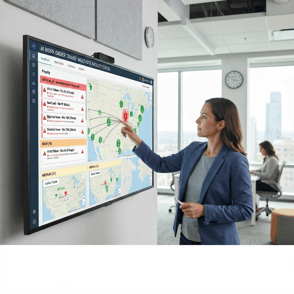
The future vision of Facilities Management by 2030 - a strategic evolution where FM transforms from reactive maintenance/cost center into AI-powered, data-driven critical infrastructure that drives business competitiveness, ESG performance, and operational resilience.
Facilities Management spent decades seen as a cost center. In 2030, it will become the intelligent infrastructure that underpins business continuity, ESG performance, and competitive advantage.
While industry leaders are already discussing how intelligent infrastructure will redefine the sector on platforms like LinkedIn, this article focuses on the “how”: how to operationalize that vision in global, multi-site portfolios, using AI, data and automation in a practical, scalable way.
As a technology partner for asset- and facility-intensive organizations, Nextbitt sees the same pattern across markets: the gap is no longer inspiration, but execution.
Discover facilities management solutions
From cost center to strategic infrastructure
The shift from “keeping the lights on” to orchestrating intelligent infrastructure is driven by four converging pressures:
- Volatile energy prices and decarbonization targets
- Stricter ESG and CSRD reporting requirements
- Aging portfolios and constrained CAPEX
- An explosion of IoT and building data that teams struggle to use
In this context, FM can no longer rely on reactive maintenance, spreadsheets, and isolated systems. To stay relevant, FM organizations need an operating model where every asset is digital, every event is data, and every decision is supported by AI.
That is the core of FM 2030: treating buildings, equipment and infrastructure as part of a smart, data-driven, AI-enabled network, not as a collection of disconnected sites.
Step 1: Create a fully digital view of your portfolio
There is no AI without data, and no usable data without structure. The first building block is a complete and standardized digital representation of your assets.
A robust FM 2030–ready model typically includes:
- A consistent asset hierarchy (region → site → building → floor → asset)
- A unique digital identity for each critical asset
- Integration with existing systems (BMS, ERP, EAM/CMMS, energy meters, IoT sensors)
- Clear ownership of data quality and governance
For many organizations, the challenge is not the lack of data, but the fact that it lives in multiple systems, formats and Excel files. Bringing all of this into a single, unified platform is what unlocks AI use cases later: predictive maintenance, energy optimization, portfolio benchmarking and more.
On the Nextbitt side, this is where we start with new customers: a data onboarding and normalization phase that transforms scattered operational data into an asset that can actually be used to drive decisions.
Step 2: Use AI to move from preventive to predictive
Once assets are digitized and data is flowing, the next leap is to move beyond time-based or checklist-based maintenance and into AI-supported predictive and risk-based strategies.
In practice, this means:
- Using historical work orders, condition data and sensor readings to train models that identify patterns before failures
- Scoring assets based on criticality, condition and business impact, so teams focus on what truly matters
- Prioritizing interventions automatically, based on real risk instead of “first in, first out”
- Continuously learning from each intervention (success, failure, duration, costs) to refine future recommendations
For FM teams, the experience changes from “responding to tickets” to orchestrating a pipeline of prioritized, high-impact actions. Field teams see clearer plans, less unplanned downtime and fewer repeated issues. Management sees better service levels, reduced OPEX and more predictable budgets.
Step 3: Make energy and ESG performance part of daily operations
In 2030, energy efficiency and ESG will no longer be separate projects or annual reports. They will become embedded in the way infrastructure is managed every day.
A modern FM platform should allow you to:
- Monitor energy use in real time, site by site, and detect anomalies automatically
- Correlate asset performance with consumption and emissions
- Simulate the impact of different scenarios (for example, replacing a fleet of chillers vs. extending life with better control)
- Produce ESG and CSRD-ready outputs based on the same operational data your teams use daily
The key shift is that sustainability moves from “documentation and compliance” to operational and financial performance. When operational data, AI insights and ESG reporting sit on the same foundation, it becomes easier for FM leaders to prove the value of their decisions to finance, sustainability and the board.
Step 4: Give leaders the right level of visibility
FM in 2030 will also be about who sees what and when.
- Local teams need straightforward views of work orders, asset status and upcoming tasks
- Regional managers need performance comparisons, bottleneck identification and risk alerts
- Executives need a concise view of availability, risk, cost and ESG performance across the entire portfolio
Modern FM platforms make this possible through configurable, role-based dashboards. On a single screen, leaders can see:
- Which sites are at higher risk due to aging infrastructure or repetitive failures
- Where energy consumption is deviating from expected baselines
- How maintenance strategies are impacting availability and customer experience
- Whether the organization is on track to meet internal and regulatory targets
This type of visibility is what finally positions FM as critical infrastructure“ownership” at board level, rather than as a technical cost line.
Step 5: Build your FM 2030 roadmap (90 days and beyond)
Moving from today’s reality to an FM 2030 model does not need to be a multi-year, all-or-nothing transformation. The most successful organizations follow an incremental roadmap, usually along these lines:
- 0–30 days – Assessment and data mapping
- Clarify portfolio scope and priorities
- Map existing systems and data sources
- Identify one or two high-impact pilot areas (for example, critical production sites or healthcare facilities)
- 31–60 days – Pilot and validation
- Onboard assets and work orders into a unified platform
- Deploy a first set of dashboards and AI-supported use cases (such as predictive maintenance on a critical asset family)
- Define KPIs and baseline them (MTBF, MTTR, SLA, energy intensity)
- 61–90 days – Scale and embed
- Extend successful use cases to additional sites
- Formalize incident playbooks leveraging data and AI insights
- Integrate FM reporting with finance and sustainability functions
From that point on, organizations usually evolve through a maturity curve: from reactive, to digital, to predictive, and eventually to autonomous and AI-assisted operations.
How Nextbitt supports your FM 2030 journey
Nextbitt was designed from day one to support asset- and facility-intensive organizations in exactly this evolution:
- A single platform to digitize assets, standardize hierarchies and consolidate data
- Native integration with IoT, BMS and enterprise systems
- AI capabilities that help you prioritize interventions, reduce downtime and optimize contracts
- Dashboards that align local teams, regional managers and C-level stakeholders
- ESG- and CSRD-ready reporting, built on top of the same operational data you use to run the business
Whether you manage hospitals, industrial sites, offices, logistics networks or retail portfolios, the direction is the same: turn infrastructure into intelligent infrastructure and FM into a strategic function.
Ready to explore your own FM 2030 roadmap?
If you are looking at how to:
- Reduce unplanned downtime and maintenance costs
- Improve energy performance and support ESG/CSRD reporting
- Gain a unified view of complex, multi-site portfolios
- Use AI in a pragmatic, operational way rather than as a buzzword
…then FM 2030 is not just a concept. It’s a concrete opportunity.
Talk to our team to explore how Nextbitt can help you design and implement your FM 2030 roadmap, starting from your existing assets, systems and teams.
Schedule a FM 2030 consultation with Nextbitt – Book here
.png?width=50&height=50&name=baixados%20(1).png)
.png?width=162&height=30&name=NB231228_wordmark_black_rgb%20(1).png)