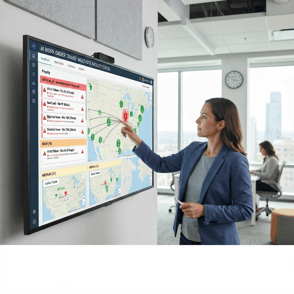
Spanish Facility Management professionals face mounting pressure to optimize costs while maintaining service quality. 78% identify efficiency as their strategic priority, yet only 30% have high operational visibility. Nextbitt can transform this paradox into competitive advantage through real-time data analytics.
Problem Context
In the Spanish FM sector, efficiency has evolved from a desirable goal to a survival imperative. According to recent sector data documented in the Comprehensive Study of the Facility Management Sector 2025, 62.6% of professionals identify cost control as their primary challenge, while 47.2% must manage complex external providers for specialized services.
This pressure doesn't emerge in a vacuum. Spanish companies operate in an environment where every euro counts, especially when margins compress and sustainability regulations intensify. Regulatory compliance, identified as a challenge by 44% of professionals, adds additional complexity to already strained operations.
Here emerges a concerning paradox that characterizes the sector. While FM is critical for business operability, its strategic recognition remains limited. Only 30% of organizations grant high visibility to their FM departments, while 47% maintain medium recognition and 23% consider low area visibility.
This disconnect between operational importance and strategic recognition creates a harmful vicious cycle: without organizational visibility, it's difficult to demonstrate quantifiable value; without demonstrable value, strategic visibility doesn't improve.
"Efficiency in FM isn't just an operational metric, it's the key to the strategic recognition the sector needs," observes Miguel Salgueiro, Chief Business Officer and Founding Partner of Nextbitt.
Technical Diagnosis
The fundamental challenge lies in data and process fragmentation that historically characterizes the Spanish FM sector. Companies manage their facilities with heterogeneous systems that don't communicate with each other, creating information silos that prevent real-time, contextualized data-driven decision making.
This situation is considerably aggravated when considering that 72.8% of professionals recognize data analytics as a priority technology, yet lack effective tools to implement it. The result is predominantly reactive, expensive, and opaque management that perpetuates problems identified in recent sector studies.
Legacy systems dominate the current technological landscape. These systems, developed before the modern connectivity era, operate as independent silos. The maintenance department uses one application, energy management another, requiring resource-intensive manual consolidation for sustainability reporting.
"You can't manage what you can't see, and most FM organizations operate with partial visibility of their most critical assets," explains Pedro Morais, CTO and Founder of Nextbitt. "The data exists, but it's fragmented across systems that don't communicate effectively."
Solutions and Trade-offs
To address these systemic challenges, FM organizations typically face three main options, each with distinct implications for their operations:
|
Solution
|
Complexity
|
Automation Level
|
Main Risks
|
|
Manual spreadsheet management
|
Low
|
None
|
High human error rate, slow response
|
|
Custom internal development
|
High
|
Medium
|
Long implementation time, high cost
|
|
Specialized integrated platform
|
Medium
|
High
|
Requires organizational change management
|
Nextbitt provides a fourth alternative that mitigates risks from each traditional approach while maximizing benefits:
- IoT sensors send data directly to the platform, eliminating manual entry and associated errors
- Automatic validation algorithms identify inconsistencies before they become operational problems
- Technical teams only intervene when exceptions are detected, freeing time for higher-value strategic tasks
"We founded Nextbitt in 2015 precisely because we identified this critical gap in the market. Existing solutions were either technologically obsolete or too generic to address the specific challenges of modern FM." comments André Calixto, CEO and Founding Partner.
Real-World Use Case
Consider a representative case of a commercial center chain with four main locations (Madrid, Barcelona, Valencia, Seville) that faced the typical challenge documented in sector studies: 25% variation in operational costs between similar centers, without clear visibility of underlying causes.
Typical Initial Sector Situation:
The chain operated with decentralized management without synergies between locations. Each center functioned as an independent island, using heterogeneous systems that didn't provide consolidated insights. Manual reporting consumed 80 monthly hours of specialized resources distributed across the four locations.
How Nextbitt Could Transform This Situation:
Implementation would begin with a strategic pilot at the most complex center (Madrid). During the first three months, occupancy sensors, energy consumption and environmental quality sensors would be installed, creating a real-time data network that would reveal usage patterns previously invisible to management.
Nextbitt would enable climatization optimization based on real occupancy measured by sensors, not potentially inaccurate historical estimates. The platform would provide real-time dashboards showing correlations between occupancy and energy consumption, identifying savings opportunities currently hidden in traditional management.
Nextbitt's machine learning algorithms would analyze visitor flow patterns, correlating them with energy consumption to automatically optimize HVAC systems. Tenant management would benefit from precise data on occupancy and space usage, improving renewal negotiations and spatial planning.
Potential Results Based on Sector Benchmarks:
- 18-25% reduction in energy consumption through real occupancy-based optimization
- 20-30% improvement in tenant satisfaction through automatic environmental management
- 100% visibility of critical operations for the first time in operational history
- 60-70 monthly hours freed from manual administrative work
- Potential ROI of 120-160% in the first year based on documented benchmarks
Stats and Benchmarks
The Spanish FM landscape presents significant opportunities documented by sector research and specialized international consulting firms.
85% of companies seek dual objectives according to recent research: improve operational efficiency AND employee well-being. This convergence marks a historical inflection point where technology can provide value across multiple dimensions simultaneously, surpassing traditional single-optimization approaches.
61% is investigating AI options for predictive maintenance, though only 27% has implemented it effectively. This 34-percentage point gap represents a significant temporal window for strategic action.
- Verifiable International Benchmarks
Organizations that have implemented data analytics and smart technologies in FM are reporting consistent results globally:
Energy Efficiency:
According to World Green Building Council data, smart buildings can achieve 25-30% reductions in carbon emissions compared to traditional buildings. JLL research documents that buildings with smart technology can achieve 5-10% higher rents and greater long-term asset value.
Predictive Maintenance:
A study published by McKinsey indicates that organizations with mature reliability-centered maintenance capabilities dedicate 70-85% of technical hours to preventive versus corrective activities. Companies implementing predictive maintenance can reduce costs by 25-30% while significantly extending asset lifespan.
Smart Building ROI:
Deloitte research demonstrates that smart green buildings can help reduce up to 30% of water consumption, 40% of energy usage, and 10-30% of total maintenance costs. IoT-enabled building management systems cost less than a third of traditional systems, with typical payback of less than two years.
57.1% prioritizes energy efficiency as the second strategic priority according to sector studies, reflecting an industry that understands the intrinsic connection between sustainability and profitability.
Product Integration and Use
Nextbitt Platform is designed as an integrated ecosystem that can grow organically with FM organizations. For sector companies, this creates operational synergies that significantly transcend the sum of individual functionalities.
Asset Management provides complete visibility of critical equipment and systems, documenting lifecycles and optimizing capital investments based on real performance data. Facility Management optimizes routine operations and schedules maintenance based on real asset condition, not arbitrary calendars that can generate costly over-maintenance.
Energy Management correlates consumption with real operational activity, generating deeper ESG insights than simple aggregated consumption metrics. This correlation enables identifying optimization opportunities that aren't evident in traditional utility bill analyses.
"Nextbitt's integrated architecture reflects how modern FM organizations actually operate. You don't manage energy in isolation from maintenance, nor maintenance independent of occupancy. Everything is interconnected, and the platform must reflect this operational reality to be truly effective." explains Miguel Salgueiro.
Final Thoughts
Spanish FM organizations that treat efficiency as a strategic function - not just an operational objective - are unlocking new value sources and building sustainable competitive advantages in an increasingly demanding market.
Technology has reached a critical maturity point where implementing advanced analytics, IoT and intelligent automation doesn't require major internal R&D investments or extraordinary technical resources. Platforms like Nextbitt democratize access to capabilities previously reserved for organizations with considerable technological budgets.
The time to act is precisely now. Companies that implement these capabilities in 2025 will have a significant and measurable advantage over those that postpone digital transformation until it becomes a defensive rather than offensive necessity.
Technical FAQ
- Can the solution handle multiple locations with different existing systems?
Yes. Nextbitt utilizes multi-tenant architecture enabling centralized management with local operational autonomy. Standard APIs integrate with most Spanish market ERP, CAFM and BMS systems.
- How is data security guaranteed in a cloud solution?
The platform rigorously complies with ISO 27001 and GDPR. Data is encrypted in transit and at rest using industry standards, with role-based access and continuous automatic audits. All servers are located in certified European data centers.
- What's the typical implementation time and expected ROI?
Based on 500+ successful implementations, typical time is 4-8 months for medium organizations. Average documented ROI is 12-24 months, with some organizations reaching breakeven in 6-8 months depending on initial operational inefficiency level.
.png?width=50&height=50&name=baixados%20(1).png)
.png?width=162&height=30&name=NB231228_wordmark_black_rgb%20(1).png)