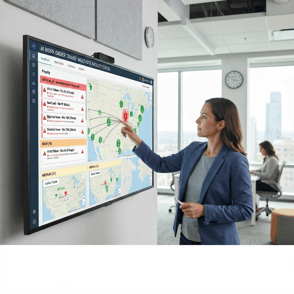
S.A.M. is powered by four AI technologies:
- Document AI automatically extracts data from invoices and reports,
- Anomaly Detection predicts equipment failures before they happen,
- Generative AI Chatbot lets users report issues in natural language,
- Cognitive Search finds assets and insights instantly.
Together, they reduce downtime by 30–40%, cut administrative time by 50%, and improve decision-making through real-time data.
The Four AI Pillars of Smart Asset Management: From Prediction to Decision
Smart Asset Management sounds powerful in theory. But what exactly does it do, and how does it work in practice?
Nextbitt's S.A.M. is built on four AI pillars that work together to transform asset operations. Understanding each pillar will show you exactly how S.A.M. can solve your organization's biggest operational challenges.
Every day, your organization receives documents: energy invoices, maintenance reports, inspection checklists, warranty contracts, compliance forms. Currently, someone has to manually read these documents and type the data into your system.
Document AI automates this entirely.
S.A.M. reads documents using optical character recognition (OCR) and machine learning, automatically extracts relevant data, and feeds it into your asset management database. For example:
-
Energy invoice → automatically extracts consumption data, cost, and facility details
-
Maintenance report → captures work performed, technician notes, parts used, and time spent
-
Inspection form → records compliance status, defects found, and remediation actions required
The impact: a team that spends 2 hours per day on manual data entry can reclaim that time for more strategic work. Over a year, that's 500+ hours of labor costs saved.
Pillar 2 – Anomaly Detection: Machine Learning That Predicts
Traditional asset management is reactive: you respond to failures after they happen. Anomaly detection flips this model on its head.
Machine learning models continuously analyze your asset data to detect abnormal patterns:
-
Consumption anomalies: A facility is consuming 20% more water or energy than its historical average → alert triggered
-
Behavioral anomalies: An HVAC unit is running 30% longer than normal → possible efficiency issue or impending failure
-
Performance anomalies: A production line is operating slower than its benchmark → maintenance or calibration needed
These models become smarter over time as they learn your specific operational patterns. A 3% rise in consumption might be normal in summer, but the same rise in winter is a red flag.
Early detection saves money. Catching a bearing failure before it destroys a €50,000 motor is the difference between a €500 repair and a €25,000 replacement, plus downtime costs.
Pillar 3 – Generative AI Chatbot: Natural Language Requests
One of the biggest sources of friction in asset management is the service request process. Technicians have to fill out forms, classify requests correctly, attach files, assign priorities. It's tedious and error-prone.
S.A.M.'s chatbot changes this. Any user can report an issue in plain language via channels they already use:
-
WhatsApp: "The lights in the storage room are flickering"
-
Microsoft Teams: "We need a plumber for the bathroom on floor 2"
-
Email: "The door lock at the entrance isn't working"
-
Nextbitt mobile app: Voice message describing the issue
S.A.M. processes the message, asks clarifying questions if needed, identifies the asset, checks its maintenance history, and automatically creates a complete work order with:
-
Correct asset and location
-
Appropriate priority (based on context and business rules)
-
Correct department or technician assignment
-
Attachments (photos, documents, voice notes)
No forms. No back-and-forth. Just results.
The chatbot works in 40+ languages and understands context across different business types (banking, healthcare, retail, manufacturing, logistics, public sector).
Pillar 4 – Cognitive Search: Find Anything Instantly
Imagine you're managing a large asset inventory across multiple locations. Someone asks: "Which of our facilities used the most energy last month?" or "Show me all critical alerts from the last 30 days" or "Find all equipment due for calibration."
With a traditional system, you'd spend 20 minutes building reports and filters. With S.A.M.'s cognitive search (powered by Azure AI), you get instant, ranked results.
Users can search using:
-
Specific terms: "ATM in branch 5" or "HVAC in building 3"
-
Vague descriptions: "that equipment on the second floor that makes noise"
-
Business questions: "Which facilities are consuming more than budget?" or "Show all overdue work orders"
-
Historical queries: "Tell me about all repairs on this asset"
Results are:
-
Ranked by relevance to your role and context
-
Connected to related data (asset history, maintenance records, documents)
-
Actionable (linked directly to create work orders, schedule maintenance, etc.)
How the Four Pillars Work Together
These four pillars don't operate in isolation. They work together as a system:
-
Document AI feeds clean, accurate data into your system from various sources
-
Anomaly detection continuously monitors this data to spot problems early
-
The chatbot makes it easy for anyone to report issues and request help
-
Cognitive search helps decision-makers find patterns and make smarter choices
Together, they create a self-improving system that gets smarter, faster and more valuable every day.
Real-World Examples
Example 1 – Healthcare
A hospital using all four pillars:
-
Document AI automatically extracts equipment service records from vendor emails
-
Anomaly detection spots that a diagnostic machine's performance is degrading
-
A technician uses the chatbot to request a service call ("MRI showing alignment issues")
-
Cognitive search confirms the last calibration and warranty status
-
Result: Preventive maintenance scheduled before patient care is affected
Example 2 – Retail
A retail chain with 200 stores:
-
Document AI pulls energy consumption data from invoices
-
Anomaly detection flags three stores consuming 15% above baseline
-
Store managers use the chatbot to report HVAC issues
-
Cognitive search shows that 5 stores have similar patterns
-
Result: Facilities team prioritizes maintenance to the stores with biggest savings potential.
What This Means for Your Organization
The four AI pillars of S.A.M. deliver:
-
Speed: Issues are handled faster because data entry is automatic and requests are simple
-
Accuracy: Predictions are smarter because they're based on complete, clean historical data
-
Cost savings: Preventive maintenance is cheaper than reactive, and energy optimization reduces spend
-
Safety: Better visibility and predictive alerts reduce risks in high-criticality environments
-
Compliance: Automated documentation and anomaly detection help meet audit and regulatory requirements
Ready to Experience Smart Asset Management?
The four pillars of S.A.M. work together to solve asset management challenges that traditional systems simply can't handle. To see them in action:
The future of asset management is smart, predictive, and surprisingly simple to use. Let's talk about how S.A.M. can transform your operations.
.png?width=50&height=50&name=baixados%20(1).png)
.png?width=162&height=30&name=NB231228_wordmark_black_rgb%20(1).png)