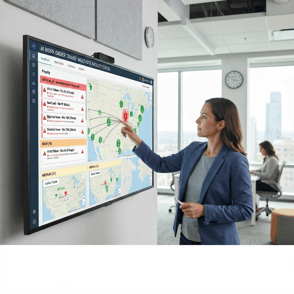
From FM to Digital Infrastructure: The Road to Invisibility
As Miguel Salgueiro argues in his recent analysis, Facilities Management will not disappear — it will become invisible: fully digital, automated, and deeply embedded in how organizations operate. Instead of a visible operational function, FM evolves into an intelligent layer of infrastructure that continuously optimizes efficiency, risk, and ESG performance.
This blogpost focuses on the practical “how”: the specific steps, technology foundations, and Nextbitt capabilities that turn that vision into operational reality for multi-site enterprises. Facilities Management is evolving from visible operations to invisible digital infrastructure; here’s your practical guide to get there.
The Three Foundations of Invisible FM
To make Facilities Management truly invisible, you need three interdependent layers that transform assets and events into continuous, autonomous decisions.
1. Complete Asset Digitalization (The Identity Layer)
Every physical asset requires a clear digital identity capturing its full operational and business context.
What this means in practice:
- Standardized hierarchy: Region > Site > Building > Floor > Asset > Component
- Digital passport: Location, technical specs, maintenance history, energy signature, criticality score
- Real-time status: IoT sensors for vibration, temperature, energy use, occupancy
Why it matters: This is the foundation — without trusted, structured asset identity, AI has nothing reliable to optimize.
2. Closed-Loop Operational Data (The Intelligence Layer)
Every intervention, event, and consumption point must generate structured data that flows back into a single system of record. This is how your infrastructure learns.
Key principles:
- Work orders capture structured data: time, materials, outcome, root cause, impacted asset
- Energy data gets contextualized: weather, occupancy, production schedule, tariffs, operating mode
- Every event automatically updates the asset's risk and performance profile
Why it matters: Decisions shift from experience-based judgment to system-level intelligence. With each ticket, kWh, and alert, your portfolio model becomes more accurate and predictive.
3. AI Decision Engine (The Automation Layer)
Here, FM fades from daily visibility: the system proposes and executes decisions automatically, with humans focused on governance and exceptions.
Automated capabilities:
- Risk-based prioritization: ML ranks interventions by business impact (downtime cost, safety, compliance, criticality)
- Real-time energy optimization: Adjusts HVAC/lighting based on occupancy, comfort, market pricing
- Compliance/ESG automation: Flags CSRD gaps, consolidates data, auto-generates auditable reports
- Vendor optimization: Scores providers by SLA adherence, cost, failure recurrence
Result: Identity provides clarity, data enables learning, AI delivers autonomous action — turning FM into an always-on decision platform.
From Vision to Execution: The 90-Day Roadmap
These foundations follow a proven, phased rollout optimized for multi-site enterprises.
Phase 1 (Days 1-30): Digital Foundation
- Define asset inventory and hierarchy
- Deploy IoT on critical assets
- Integrate data lake (BMS, CMMS, ERP)
KPIs: 100% digital identity coverage
Phase 2 (Days 31-60): Intelligence Build
- Digitize work orders with feedback loops
- Establish baseline energy signatures
- Train initial risk scoring models
KPIs: 80% structured data capture
Phase 3 (Days 61-90): Automation Launch
- Deploy AI decision engine
- Test automated prioritization (top 20% risk assets)
- Activate ESG reporting automation
KPIs: First 10% autonomous decisions
Proven Results: CUF Healthcare Network Transformation
These steps deliver measurable impact at scale. Consider CUF's network (2,259 users, 54,898 assets, 909,511 work orders, 21 clinics, 14 hospitals):
- Automated critical processes reduced errors, failures, and unexpected downtime
- Real-time SLA monitoring via dashboards increased transparency and rapid adjustments
- Standardized asset/maintenance processes across the entire network
The New FM Leader's Dashboard: 5 Strategic Metrics
Forget 50 KPIs. Invisible FM reduces to 5 strategic metrics:
|
Metric
|
Target
|
Why It Matters
|
|
Autonomous Decisions
|
>30%
|
Measures AI maturity
|
|
Risk Coverage
|
100% critical assets
|
No surprises
|
|
Energy Intelligence
|
<5% variance
|
ESG + OPEX
|
|
Data Loop Closure
|
>90%
|
Continuous learning
|
|
Strategic Impact
|
€/asset value
|
C-suite relevance
|
Why Now? The Convergence Moment
Three forces converge now:
- AI maturity: Models now grasp operational context, not just patterns
- Regulatory pressure: CSRD/ESG demands automated, auditable data
- Economic reality: Energy volatility + capex constraints require smarter operations
FM leaders acting in 2026 build structural advantages in resilience, compliance, and capital efficiency.
Nextbitt: Your Invisible Infrastructure Partner
Nextbitt powers this transformation with:
• IoT-native data collection
• Closed-loop AI decision engine
• ESG/CSRD automation
• Multi-site, multi-language scalability
It's time to evolve FM from cost center to strategic intelligence. Schedule your FM 2030 assessment to see how Nextbitt builds invisible infrastructure from your current assets, systems, and teams.
Schedule your FM 2030 assessment
.png?width=50&height=50&name=baixados%20(1).png)
.png?width=162&height=30&name=NB231228_wordmark_black_rgb%20(1).png)