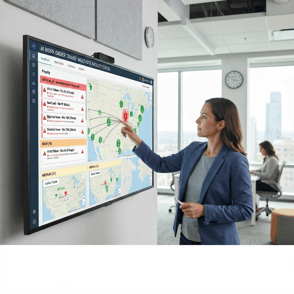
Most organizations treat energy and water as separate stories. Energy gets its own reports, dashboards, and projects. Water is handled somewhere else, often with different tools, teams, and priorities.
On paper, this separation feels harmless. In operations, it creates blind spots.
Energy and water are both consequences of how a site operates: how equipment runs, how spaces are used, how processes are designed, and how maintenance is performed. When the data lives in different places and follows different workflows, decision-makers only see fragments of the picture.
Bringing energy and water data into the same workflow is less about consolidating reports and more about aligning how the organization understands, manages, and improves resource use.
Two utilities, one operational reality
From an operational point of view, energy and water are deeply connected:
- HVAC, cooling towers, boilers, sterilization and cleaning processes often use both.
- Leaks, inefficiencies, and failures can affect one or the other—or both at the same time.
- Maintenance actions frequently have an impact on consumption patterns.
If energy and water are analyzed in separate silos, teams may:
- miss shared root causes behind anomalies;
- duplicate investigation efforts;
- or optimize one resource while worsening the other.
A single workflow changes this by letting teams see how events, assets, and resource use interact.
The cost of split workflows
When energy and water data live in separate systems, a few things tend to happen:
- Different owners, different priorities
One team might be focused on energy efficiency, another on water loss or compliance. Without a shared workflow, alignment is harder and trade-offs are not always visible.
- Fragmented alerts
An energy spike might trigger an alarm in one system while a water anomaly is flagged elsewhere. No one sees that both patterns started after a specific asset change or maintenance event.
- Manual correlation
Analysts or managers end up exporting and comparing spreadsheets, which is slow and error-prone. By the time a pattern is spotted, the opportunity to act may have passed.
The result is that issues stay longer in the system and savings that could have been captured earlier are left on the table.
What “one workflow” really means
Putting energy and water data in the same workflow does not necessarily mean one big dashboard. It means that:
- events are captured in a consistent way;
- alerts follow a similar path;
- actions are logged in the same system;
- and responsibility for follow-up is clear.
In practice, this looks like:
- An energy or water anomaly automatically generating a work order.
- The work order being routed to the right facilities or maintenance team.
- The action and resolution being recorded against the same asset and site.
- Performance being reviewed later with both resource and operational data on the table.
This creates a closed loop: anomaly → investigation → action → verification.
How this helps operations
For operations teams, a unified workflow means fewer surprises and more context.
Instead of receiving isolated “energy alerts” with no operational explanation, teams can see:
- which equipment or area is affected;
- what else has changed in that site;
- whether there are related incidents or open work orders;
- and who is responsible for acting next.
That makes it easier to:
- prioritize interventions;
- avoid duplicated work;
- and connect resource consumption to concrete operational decisions.
It also reduces noise. When energy and water data share the same workflow, many false positives disappear because patterns are evaluated in a richer context.
How this helps sustainability and ESG
Sustainability and ESG teams need reliable, auditable data on resource use. But they also need to know why consumption behaves the way it does.
A shared workflow helps them:
- link resource data to assets, sites, and events;
- understand when a deviation was due to intentional operational changes versus faults or leaks;
- document corrective actions in the same system as the anomaly;
- and build stronger, audit-ready narratives for reports and disclosures.
Instead of reporting numbers in isolation, they can show a chain of evidence: detection, action, and impact.
The role of maintenance and facilities
Maintenance and facilities teams are often the ones who act when an anomaly is detected, whether it is energy, water, or both.
When energy and water workflows are aligned with maintenance:
- teams get a clearer view of how their work affects resource performance;
- they can see which assets systematically cause spikes or losses;
- and they can prioritize replacements or upgrades based on combined impact.
In other words, they become part of a broader resource management strategy, not just responders
What a unified workflow looks like in practice
A practical unified workflow usually includes:
- Centralized data capture
Energy and water readings, sensor data, and meter information feed into a single platform.
- Shared anomaly detection rules
Deviations from expected patterns trigger standardized events, regardless of whether they are energy or water-related.
- Integrated work order management
Events automatically create or update work orders linked to the right site, asset, and responsible team.
- Common follow-up and documentation
Actions, findings, and resolution status are logged in the same place.
- Joint review of results
Operations, maintenance, and sustainability review performance together, using the same data.
This is not about building a perfect workflow on day one. It is about making sure resource data and operational actions are part of the same story.
How Nextbitt can support this model
A platform like Nextbitt can help organizations:
- centralize energy and water data alongside asset and maintenance records;
- configure shared workflows for anomalies and alerts;
- track the full lifecycle of an event, from detection to resolution;
- and give operations and ESG teams a common view of performance.
By keeping everything in one ecosystem, organizations move from managing “energy projects” and “water projects” separately to managing resource performance as part of daily operations.
Conclusion
Energy and water do not behave in isolation, and neither should their data.
When both live in the same workflow, organizations gain a clearer view of how operations drive resource use, where risks and inefficiencies are emerging, and which actions create real impact.
Bringing energy and water together is not just a reporting choice. It is an operational one.
If your energy and water data still live in separate workflows, it may be time to bring them together. Explore how Nextbitt can help centralize resource data, connect it to assets and operations, and turn anomalies into coordinated action.
Schedule your Demo
.png?width=50&height=50&name=baixados%20(1).png)
.png?width=162&height=30&name=NB231228_wordmark_black_rgb%20(1).png)