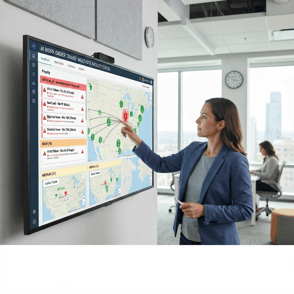
Monitoring Tells You the Problem, Automation Fixes It
Most large organisations already have some form of energy monitoring. Sensors, dashboards and weekly reports are now standard for modern facilities.
The uncomfortable truth is that monitoring alone is not enough. If the response still depends on emails, phone calls and spreadsheets, much of the potential saving never materialises. Alerts are ignored, decisions are delayed, and actions are not consistently executed.
The companies reporting 20–30% energy savings are the ones that took the next step: they automated the response. That is where Nextbitt’s energy automation workflows come in.
The Monitoring Gap: Where Savings Are Lost
Even with sophisticated dashboards, three factors limit impact:
-
Alert fatigue: too many alerts; it becomes impossible to distinguish critical issues from noise.
-
Response delay: days pass between seeing an alert, creating a ticket and carrying out an intervention.
-
Inconsistent action: different sites respond differently to the same problem.
Without automation, organisations typically capture only 30–40% of the savings that their monitoring systems identify.
The Solution: Energy Automation Workflows
In the Nextbitt platform, energy stops being just a set of charts and becomes a set of intelligent workflows.
From Event to Action
When the EMS or the IoT platform detects a significant consumption deviation, the system:
-
Classifies the event by severity, financial impact and likely root cause.
-
Triggers the appropriate workflow automatically (work‑order creation, supplier notification, validation request, etc.).
-
Sets SLAs and owners, tracking the full lifecycle until resolution.
There is no room for “we forgot that alert” or “I did not have time to open the ticket”. Automation guarantees coverage.
Predictive Maintenance for Energy Efficiency
By combining consumption data, asset age and maintenance history, the platform identifies degradation patterns that manifest as over‑consumption.
Instead of waiting for a spike or a breakdown, predictive maintenance for energy efficiency schedules interventions before the problem becomes expensive.
Real Story #1 – EDP: 70,000 Work Orders, Unified and Automated
Scale: 1,000 facilities, 22,000 assets, 500 daily users, around 70,000 work orders per year.
At this scale, managing energy and maintenance manually would be impossible. EDP needed a solution that ensured strict control and fast response across a continental footprint.
With Nextbitt:
-
All facilities and assets are managed on a single platform, including both energy and maintenance data.
-
Workflows are defined for every type of intervention, from preventive maintenance to responses to abnormal consumption.
-
Consumption alerts (water, energy) automatically generate work orders with the right teams and suppliers assigned.
Tiago Cardoso, Head of Finance & Systems at EDP Facilities Division, summarises the impact:
“Currently, we have about 1,000 facilities in the system under our management, with a total of 22,000 assets. In total, we have 500 users working on the platform daily, where 70,000 work orders are created per year. By using a centralized platform like Nextbitt, we achieve strict control and a quick response to various needs.”
By automating much of the “detect → act → confirm” cycle, EDP shortens response times and ensures that no relevant event is left unmanaged.
Get to know the full story here.
Real Story #2 - Termogod: 100% Preventive Maintenance, Zero Missed Obligations
Sector: Multi‑site maintenance & contracts
Termogod’s main challenge was ensuring that all contractual maintenance obligations were executed on time, without relying on fragmented calendars and spreadsheets.
Before Nextbitt:
After Implementation:
-
Assets and contracts integrated into a single platform.
-
100% of preventive maintenance scheduled automatically, based on contractual plans and manufacturer recommendations.
Mauro Cotrim, Contracts Manager at Termogod, explains:
“Our biggest challenge was to keep contracts and assets organized efficiently. We had difficulties ensuring that all maintenance obligations were met on time. The main problem was the lack of a clear, centralized view of assets and contracts.
With the Nextbitt platform, analysis and response times have improved considerably, and we know that ‘time is money’. In addition, today 100% of our preventive maintenance is scheduled automatically, which ensures efficiency and total control.”
Although this case focuses on maintenance, the impact on energy is direct: well‑maintained equipment runs more efficiently, has fewer consumption peaks and fewer critical failures.
Read the full case here.
From Monitoring to Automation: The Numbers
Market benchmarks report that organisations that combine monitoring + automation witness significantly stronger results:
-
Average energy savings: 20–30%, versus 5–10% with monitoring alone.
-
Response time to critical consumption events: from 2–5 days down to 2–4 hours.
-
Preventive maintenance compliance: from 60–80% up to 98–100%.
Energy automation does not eliminate the need for teams; it extends their reach by removing repetitive tasks and guaranteeing consistent action.
Implementing Energy Automation in Your Organisation
If you already have some level of monitoring (BMS, smart meters, dashboards), the next step is to connect those data sources to the Nextbitt platform and activate automated workflows:
-
Map current processes for responding to alerts and managing maintenance.
-
Configure energy automation workflows in the platform (who does what, in which timeframes, with what priorities).
-
Integrate energy with maintenance so that relevant deviations automatically generate work orders.
-
Activate automated reports for executives and ESG teams.
Conclusion: The Future of Energy is Automated
Nowadays, it is not enough to know where energy is being used. Organisations must ensure that, every day and around the clock, they automatically act on what data reveals.
The combination of IoT, EMS and energy automation workflows in Nextbitt enables exactly that:
-
Detect problems in minutes.
-
Trigger the right response without friction.
-
Make maintenance and energy efficiency work together.
That is how companies move from “monitoring consumption” to achieving 20–30% savings — and how energy shifts from being just a cost to becoming a driver of value.
If your teams are still manually chasing alerts and work orders, now is the time to turn monitoring into automatic, measurable savings.
Talk to an Energy Automation Expert
.png?width=50&height=50&name=baixados%20(1).png)
.png?width=162&height=30&name=NB231228_wordmark_black_rgb%20(1).png)